.svg?width=174&auto=compress,webp&upscale=true)

Reading time 3 min
Bregt Coenen
 Peter Jans
Promises and good intentions from the vendors. A steady stream of headlines on social media and the trade press. But where do we actually stand today on digital sovereignty? Our Cloud & DevOps Director Peter Jans puts together his own state of the union. What are the American cloud vendors doing? What is Europe putting up against it? And what should that mean for you as a Belgian business?
Let's first take a quick step back together. Context, clarity and nuance matter in this discussion around digital autonomy.
Digital sovereignty is the ability of a country or a business to stay in control of its own digital future. It covers a lot more than just where data physically sits (data residency).
In 2026, we define digital sovereignty around three pillars:
Ongoing geopolitical tension between the United States and the European Union makes it difficult to reach agreements on managing, processing and exchanging sensitive data. A data privacy framework matters, because many European businesses are hugely dependent on American cloud providers
What happens if the worst-case scenario becomes reality and European law shuts American cloud enterprises out? What if AWS, Azure and Google's cloud services become legally off-limits in Europe? Or the other way around: what if the US government claims access to data belonging to European businesses? How far does the CLOUD Act really reach in practice, given that it allows the US government to demand access to data under certain conditions? Recent events show that there have already been real cases of data being leaked, or access being cut off.
How are the three big cloud players, Amazon Web Services (AWS), Microsoft Azure and Google Cloud Platform (GCP), navigating this uncertainty?
Their strategy is clear: reassure European customers with dedicated "sovereign" offerings, without cannibalizing their global model. But how does that translate into concrete steps for the digital sovereignty of Belgian businesses?
AWS is betting heavily on the AWS European Sovereign Cloud (Germany, Brandenburg), fully operational since January 2026. It's a separate, independent cloud infrastructure, physically, operationally and logically separated from AWS's existing regions.
The core promise: all customer data, including metadata, stays within the EU and is managed exclusively by EU-based, EU-vetted staff.
Critics still point to the American parent company. Because AWS US remains part of the contracting structure, the reach of US law stays a point of concern.
Microsoft continues to build out its Microsoft Cloud for Sovereignty, in effect since early 2026. This isn't a separate cloud, but an extensive set of policies, guardrails and tools layered on top of the existing Azure cloud. It lets customers configure a "Sovereign Landing Zone" that meets strict compliance requirements.
Azure pairs data residency guarantees with advanced encryption and confidential computing, keeping data encrypted even while it's in use.
In December 2025, Microsoft also launched ABC (Azure Belgium Central), a brand-new region for the Belgian market.
The latest Microsoft updates on digital sovereignty, straight from the source:
Google also expanded its sovereignty options in 2025. With Google Cloud Data Boundary, customers can strictly define the geographic boundaries for where their data is stored and processed.
Google also offers Google Cloud Dedicated, an air-gapped or hybrid solution delivered together with local partners (such as T-Systems in Germany, and together with Proximus in Luxembourg) to meet the strictest local sovereignty requirements from governments.
Now, over to Europe: could the key to our digital autonomy actually lie closer to home? Especially in combination with open source. We joined the Eurostack initiative as a co-supporter back in October 2025.
SUSE has, since last year, positioned itself firmly as a European champion of the open, sovereign cloud. With the recent signing of the EuroStack letter, SUSE, together with other European tech companies, is pushing for a stronger focus on sovereign European digital infrastructure.
For Belgian organizations, SUSE's portfolio, think Rancher for Kubernetes management and NeuVector for container security, offers concrete tools to avoid vendor lock-in. For SUSE, real sovereignty starts with the freedom to choose where and how you run your applications, independent of the underlying cloud provider. That opens the door to combining it with other players.
Several European players are active today too. Here's an overview of a few worth keeping an eye on.
Provider |
Country |
In short |
SUSE Rancher support |
|
FR |
Developer-oriented, with interesting options |
Yes |
|
|
DE |
Strong capabilities and competitive pricing |
Yes |
|
|
FR |
French cloud and hosting provider with a broad range of services |
Yes, managed Rancher support |
|
|
DE |
Cloud provider that grew out of Lidl, currently building a third data center (200MW) |
- |
|
|
FI |
Cloud servers and managed services aimed at developers and SMEs, with 15 data centers worldwide |
- |
Cloud native is a strategic enabler for digital sovereignty, by building applications and infrastructure on open-source standards such as Kubernetes and containers.
A cloud-native architecture makes applications, data and systems inherently portable. A container running on AWS today can run on Azure, a local Belgian cloud provider, or an on-premise cluster tomorrow, with minimal changes.
This breaks the classic vendor lock-in that comes from relying on proprietary services from the hyperscalers. Organizations that standardize their infrastructure on Kubernetes create an abstraction layer that gives them the flexibility to move workloads to whichever cloud best fits their sovereignty requirements at any given time.
The Cloud Native Landscape and Cloud Native Trail Map give you an overview and a roadmap to get started.
➡️ Choose a Cloud Native-first design for your IT today, regardless of whether you're on public cloud, private cloud or on-prem. It's an investment now, but it buys you more room to move later.
The NIS2 directive, in force under Belgian law since late 2024, draws a direct line between cybersecurity and sovereignty. NIS2 requires organizations in essential and important sectors (energy, transport, healthcare, but also digital service providers) to take strict risk management measures and report incidents.
The connection to digital sovereignty runs two ways:
That covers the theory and the latest developments. One question remains: what should you and your business actually do with this? We see four possible levels, ranging from full trust in the American three to complete decoupling.
Managed
Self-served
On-premise using open tools from a provider (for example, SUSE and Rancher RKE2).
Wherever your starting point is, and whatever your plans look like, we have the knowledge and experience to guide you toward the right solution. Whether we write the strategic plan together with you, or help you bring your own plan to life: let's get in touch.
But let one piece of advice be crystal clear: choose Cloud Native solutions built on containers and Kubernetes today, without hesitation. They give you freedom of choice down the line, and that's what all of us are after in a changing world.
If you'd rather map things out yourself first, this checklist can help.
Disclaimer: given how fast this topic evolves, it's worth continuing to check current, reliable sources as well.
Checklist for security and digital sovereignty
Balancing innovation, security and sovereignty takes a deliberate approach. Use this checklist as a guide for your strategy:
Below is a table you can use to conduct your own analysis of another public, private, or on-premises infrastructure. We also used this table to analyze other providers based on our requirements.
Capability |
Available |
|
Infrastructure service |
|
|
Compute Service - Server and Serverless |
|
|
Storage Services - S3, EBS, EFS |
|
|
Database Services - RDS, DynamoDB, … |
|
|
Container Services - Kubernetes Service, Container Service |
|
|
Certificate Services - ACM |
|
|
Networking Services - VPC - Route53, CloudFront, NLB / ALB, DNS, CDN |
|
|
Security Services - WAF, IAM, Config, Secret, Auditing, CloudTrail |
|
|
CICD Services - Registry, Pipelines, … |
|
|
Redundancy Services - Multi Region, Multi AZ |
|
|
Backup Services |
|
|
SLA Services - Uptime Guaranties |
|
|
Compliance Services - ISO27001, NIS2, HIPAA, … |
|
|
Pricing Services - Transparent & Open Calculator |
|
|
Logging Services - CloudWatch Logs & Metrics |
|
|
DevOps |
|
|
Infrastructure As Code Integration (Terraform, OpenTofu, …) |
|
|
Observability Integration |
|
|
FinOps Integration |
|
|
Alerting Integration |
|
|
SUSE Rancher Integration |
|
|
Support |
|
|
Business, Enterprise & Technical Support |
|
|
Online Documentation |
|
|
Community Driven |
|
|
Market Presence |
|
|
References |
|
Let's put it into practice together!
Contact Peter Jans for a free call or check out our cloud services.
CloudNative Architect and team member Bregt Coenen, looks at AWS Transform, the AI tool AWS built to speed up legacy modernization. In this blogpost he covers what the tool does today, what changed with AWS Transform Custom and why the newest contain
Read more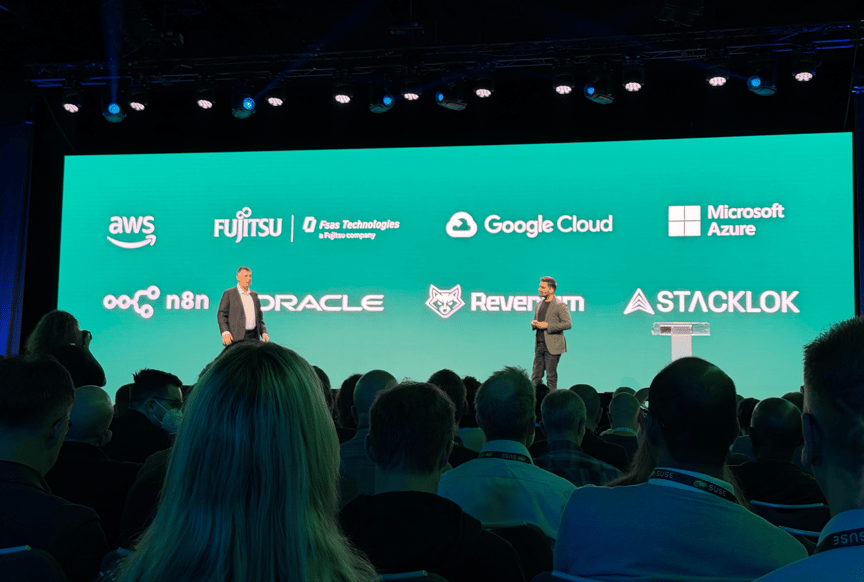

ACA Group joined over 2,000 attendees at SUSECON 2026, and one thing was clear: SUSE is accelerating its momentum in Europe, especially around digital sovereignty, AI, and edge computing.
Read more

A few years ago, AI felt like a fantastic gimmick. Last week in Amsterdam, that illusion fell apart completely. I've been part of the circus that the IT sector sometimes is for many years now. Just when you think you've seen everything, reality catch
Read moreGet in touch with our experts today. They are happy to help!

Get in touch with our experts today. They are happy to help!