


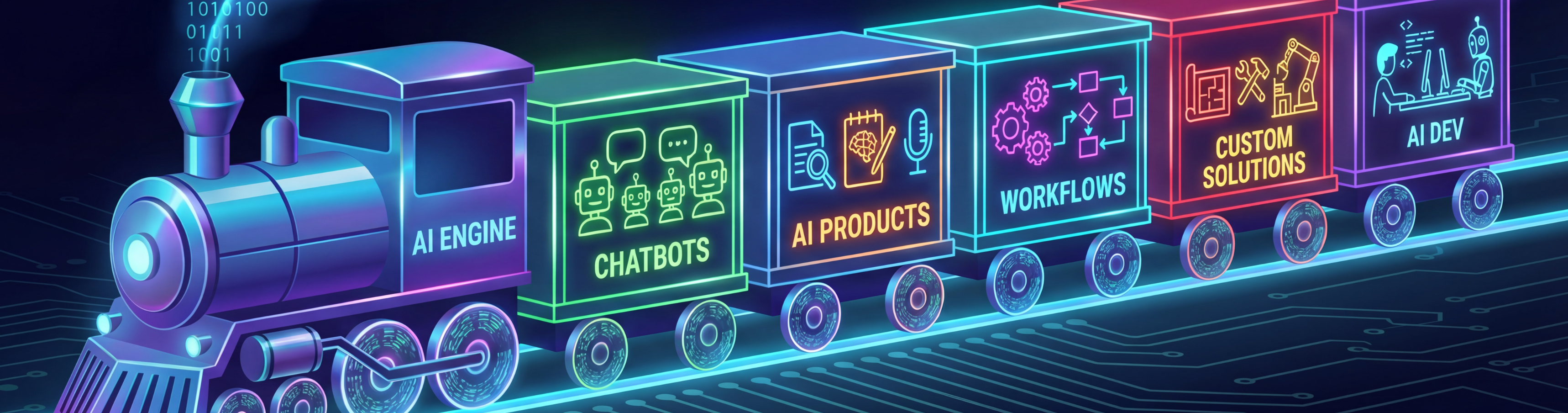
The AI train: where does the real AI impact lie for your company today?
Has your company already settled into the seats of first class, or have you not yet found your place on the AI train? Our AI expert Alexander Frimout explains which processes are ideally suited for your first AI business case. And why some companies aren’t sitting in the best wagons…
The possibilities are enormous. The use cases that prove this are expanding at a rapid pace. Many companies therefore feel the pressure to do something with AI.
But what exactly is that something? Where do you start as a company with your first AI business case? How do you identify the tools that truly add value to your business? Or put differently: in which wagon of the train below should you take a seat?
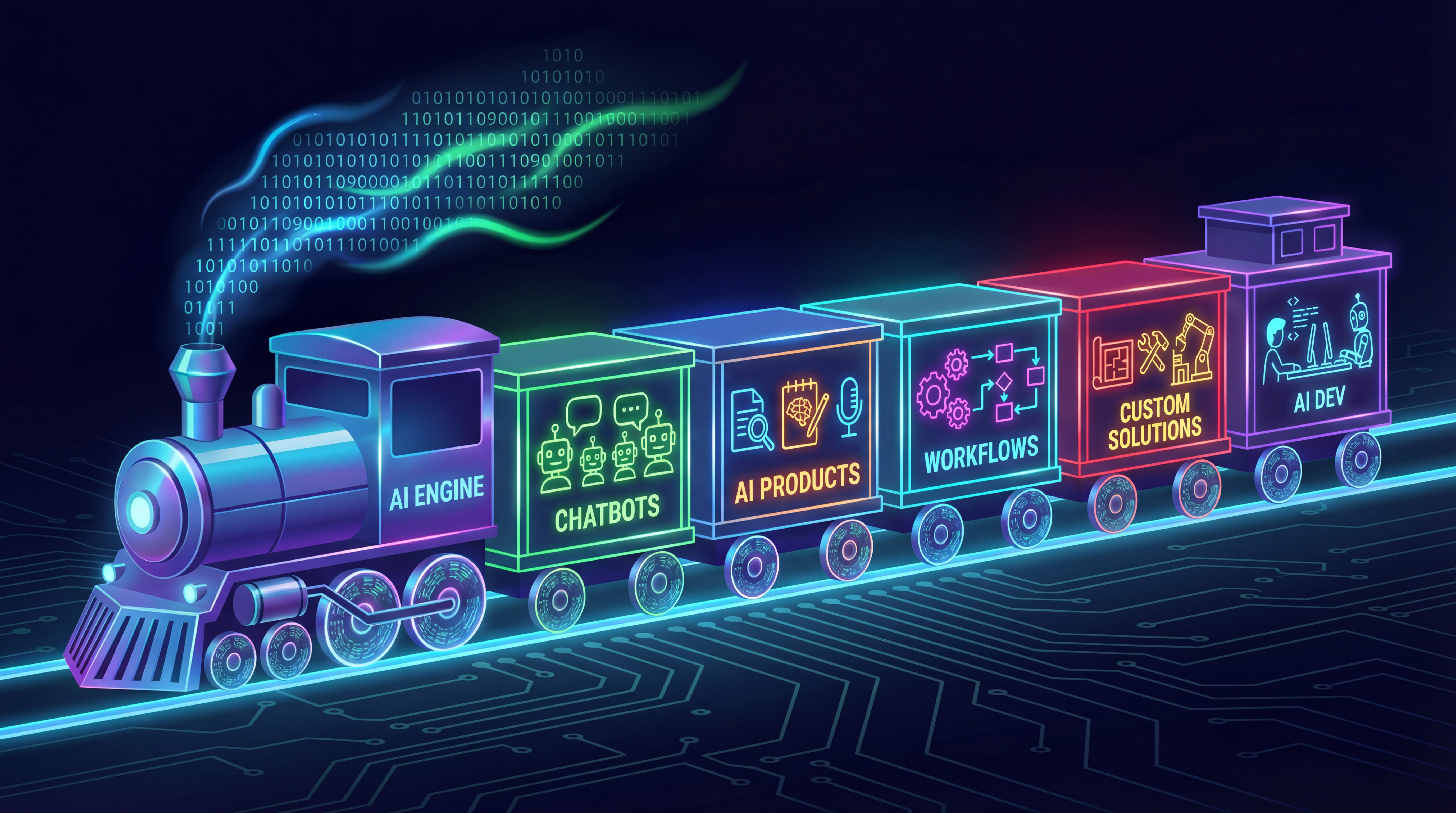
For many companies, that means the doors of the first wagon right behind the locomotive: chatbots.
Why there?
Probably because the ChatGPTs and Geminis of this world are the AI technologies we feel most familiar with. Of all the tools, platforms, and apps, chatbots are the most widely known to the general public. That makes the threshold to use them in a professional context just a little bit lower.
Chatbots: the AI business case without ROI
Yet this very wagon is the least interesting for companies, according to Alexander.
“Chatbots improve your personal efficiency. But their impact at company level? Limited. I’ve never spoken with a company that could present a concrete return on investment.”
“And yet, this is exactly what happens in many companies: we roll out 100 licenses of Microsoft Copilot and call it a day. What those colleagues actually do with it remains vague. As a company, you can tick the AI box, but in my view, it doesn’t deliver real value. It’s not a полноценный business case with a clearly defined ROI.”
Technology: the last four wagons
According to Alexander, the real gains lie at an intersection. The intersection between the last four wagons and back-office applications.
First, a quick explanation of those wagons.
- AI Products: ready-made AI integrations within platforms and tools such as your Customer Relationship Management (CRM), Enterprise Resource Planning (ERP), or Warehouse Management System (WMS).
- Workflows: automation of tasks (for example with n8n) for those who are less technically inclined. Think of automatic lead follow-ups or invoice reminders.
- Custom Solutions: tailor-made software that seamlessly fits your unique business processes. Here, the sky’s the limit.
- AI Development: tools such as Claude or Lovable that help your developers write code faster and with fewer errors.
Technology: check. Now let’s look at the business processes that are most relevant for your very first AI business case.
Processes: integrated back-office applications
The most interesting AI business cases are concentrated in back-office applications that are well integrated with existing software.
Think of LLMs that help your customer service teams respond faster. Or custom software that scans delivery notes and automatically converts them into a standard template.
Why are these processes the most interesting?
- They happen on a computer and are therefore digital.
- There is interaction with other software systems. Think of a mailbox, a CRM system, or warehouse management. There is already a certain structure in the data. And that data already lives within your company’s ecosystem.
- Language is still the best input for language models.
- They are repeatable processes. Such as entering delivery notes, answering simple emails, or creating invoices.
- The added value of human expertise is often limited for many of these tasks. Precisely because they are the digital equivalent of manual assembly line work. Why should your colleague answer 49 similar customer emails if that means they have less time for the one email where their expertise truly matters?
AI business case in practice: Decomecc
Let’s make that intersection between AI technology and back-office processes more concrete.
Meet Decomecc. This company from Genk processes aluminum and (stainless) steel: cutting to size, sawing, applying coatings…

At their site, trucks constantly come and go, delivering coils like the one in the image above. Decomecc processes around 20 to 30 deliveries per day.
The situation before…
Administrative staff had to check every delivery and delivery note:
- What exactly is being delivered?
- Is the delivery correct?
- Which project/customer does this coil belong to?
- And so on and so on.
This meant: reading the delivery note, searching in the database, manually retyping the information…
In the best case, this takes about 15 minutes. But not every driver immediately has the correct paperwork. And not every colleague finds the right data just as quickly. On top of that, manual work always comes with a margin of error.
The situation now
The employee scans the delivery note. It is automatically sent to the custom AI tool we built for them. The tool then searches for the correct information and matches it with the internal database.
Within a minute, the employee receives a proposal:
- This is, in my view, the project this delivery note belongs to. With a confidence score out of 100%.
- These are the details I will complete after your approval.
As a result, the employee now has time to focus on the delivery notes the AI tool cannot immediately identify. For example, because the delivery note is incorrect, the driver delivered on the wrong day, or the order itself is wrong.
The end result?
- Lower error rate
- Faster processing
- Internal projects can start sooner
- Better stock management
- And fewer frustrated drivers at reception
🎥Watch the full video to see how we helped Decomecc automate their administrative paperwork.
Ready for departure: your AI checklist
Do you already have an idea which back-office processes would be ideal for your first AI business case? The more boxes you can tick on the checklist below, the more relevant it becomes.
 What is the cost of the problem today?
Are there quality risks (impact of human/AI errors)?
Is there “reference data” to compare with, or does the system need to create data (e.g. orders)?
What is the role of the human reviewer?
Are the systems the AI needs to interact with accessible?
How standardized is the work / how many exceptions are there?
Are there other constraints? (security, processing speed, …)
On the rails…
All boxes checked? Then we’ll help you in the next step to determine the ROI and translate your case into a technical solution.