DemoBlog 1
logo Demo Blog

Last updated: 28 April 2026

Data Mesh as a backbone for European building logbooks

The European Demo-BLog project, focused on digital building logbooks for energy efficiency, faced challenges with fragmented building data across governments, utilities, and construction stakeholders. ACA Group developed a Data Mesh proof of concept, implementing a self-service data platform with decentralized ownership and data product principles. This approach enabled scalable data sharing and interoperability, demonstrating how a Data Mesh architecture can support data-driven services, improve access to building data, and accelerate energy-efficient decision-making across Europe.

Read more
Share this via:
01

Challenge

Transparency and access to building data are critical to upscale building renovation in order to achieve a climate neutral building stock. But that data is spread across different parties.


02

Solution

It was up to us to develop a proof of concept that demonstrates the potential of a Data Mesh approach to address these fragmented data ecosystems.


03

Approach

A self-service Data Mesh platform with decentralised ownership. This means that no central data team is required, and the platform makes it as easy as possible to create new data products.


04

Outcome

An ecosystem that enables seamless data sharing and reuse between building logbooks and associated stakeholders, such as policy makers, researchers, and energy efficiency organizations. 

logo Demo Blog

About Demo BLog

This European project focuses on how Digital Buildings Logbooks can accelerate energy-efficient renovations. How can such a digital logbook bring together data and make it comprehensible? And how can we then use that data to make the right choices for our building stock?

Challenge

Building-related data sources are fragmented across organizations

Improving a building’s energy efficiency involves making decisions. And to get those decisions right, you need data: heat demand, roof orientation, electricity consumption, etc.

But building-related data sources are often fragmented across various organizations, including government agencies, utility providers, and construction companies.

In the sector of building logbooks, there is a fragmented network of potential existing and new 'building-related' data sources. The extremely limited availability of information, combined with a lack of a common repository of data through a shared platform, directly leads to additional costs and inefficiencies in designing, constructing, operating, and financing buildings.

This is making it difficult for teams to share and reuse data effectively.

DemoBlog 2
Solution

A Data Mesh approach

The Building Logbooks developed to date rely on point-to-point integrations towards individual data sources to collect data. It is then up to a central team to organise the data and make it available for the many data use cases and data sources. Moreover, each building logbook initiative in Europe has this same challenge which would result in multiple such teams.

Avoiding the typical bottlenecks?

“In an environment with so many different stakeholders, this way of working quickly reaches its limits and is not scalable. That one central team becomes the bottleneck”, says Tom De Wolf, Innovation Lead and Data Mesh Expert at ACA Group.

Provide flexibility and simplify exchange of data

Enforcing a common data interface protocol on all building logbooks or source systems is a common data exchange strategy. Research proved that it is not advisable due to the diverse nature of the current landscape, the effort it would take for each data owner, and the optimal protocol also depends on how the data is to be reused and consumed. It is better to enable stakeholders with a method of data exchange supporting multiple protocols and lowering their individual effort and complexity to do so.

"This calls for an open data platform through which data can be discovered, exchanged and integrated. For this particular project, Data Mesh proved to be the best possible choice.”

What are the four major advantages of Data Mesh for this European project?

  1. Decentralised ownership: enabling a scalable data ecosystem by distributing the responsibility to share and reuse data.
  2. Data as a product: makes data easily reusable for an infinite number of use cases.
  3. Self-service data platform: lowers the cognitive load for teams to share and reuse data. Also lowers the total cost of ownership by providing a shared platform and easy to use self-service tooling to discover, share and consume data products.
  4. Federated computational governance: governance by a team of representatives and experts with a focus on interoperability between data products.

The Data Mesh concept can bring diverse benefits to the DBL ecosystem. By providing a common data environment where the latest data is accessible, a Data Mesh for the DBL industry can enable more effective interactions between DBL stakeholders, which usually act in different domains, operate with different IT structures, and have different access rights.

Jerson Amorocho
Researcher
BPIE logo
Jerson Amorocho
"The Data Mesh concept can bring diverse benefits to the DBL ecosystem. By providing a common data environment where the latest data is accessible, a Data Mesh for the DBL industry can enable more effective interactions between DBL stakeholders, which usually act in different domains, operate with different IT structures, and have different access rights."
Jerson AmorochoResearcher
BPIE logo
Jerson Amorocho
Approach

One way of working, endless possibilities

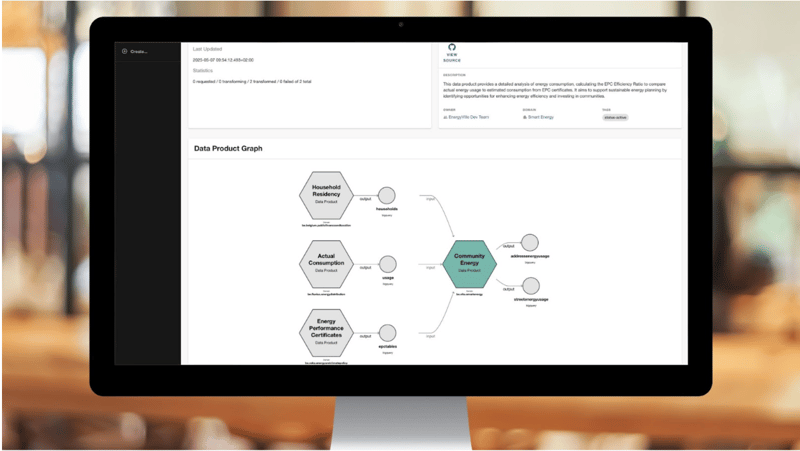
We developed a Data Mesh platform proof of concept and demo on how data exchange and sharing can be facilitated in a new and innovative way.

We focused on building a self-service data platform as the key enabler, empowering data producers to create Data Products and take ownership of their data in a decentralized manner.

Tom De Wolf: “Data Mesh puts the ownership as close as possible with the experts of that data. Because they are best placed to manage that data as effectively as possible and make it available in a ready-to-use format. So that the data is available to the rest of the ecosystem.’”

“This makes it easier to share data as a product. Not: here's a data dump, figure it out yourself. But insightful data that others can use as a basis.”

Demoblog 3
Result

Data Mesh platform as a backbone

We demonstrated the feasibility and the potential of a Data Mesh platform to enable use cases such as providing actionable insights for policymakers at the European level, and advanced use cases around energy efficiency optimization.

This underscored the potential of Data Mesh as a backbone for collaborative ecosystems in the building sector to share and reuse data.

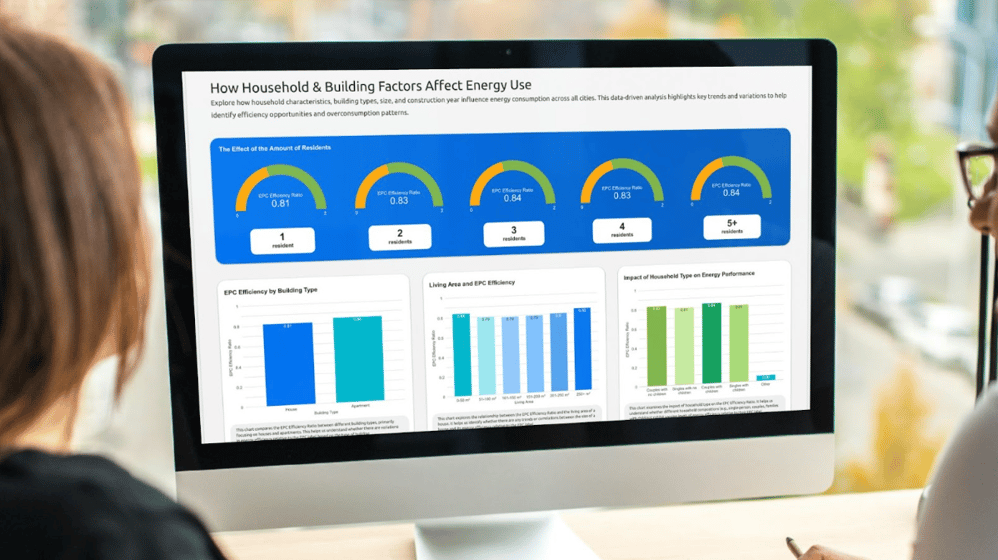
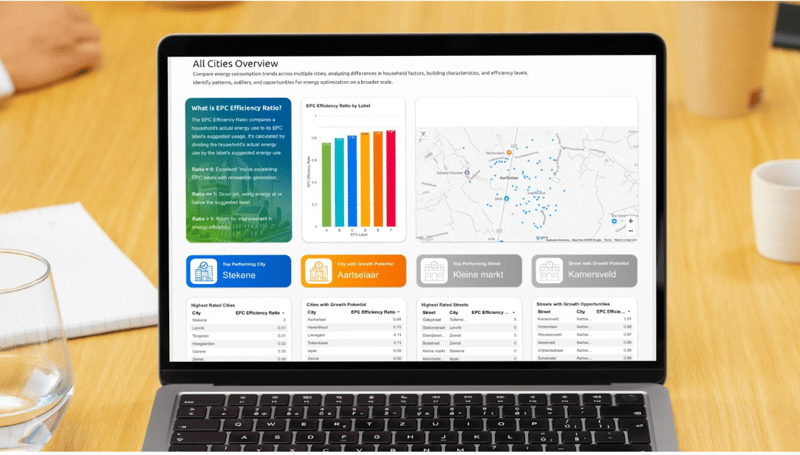
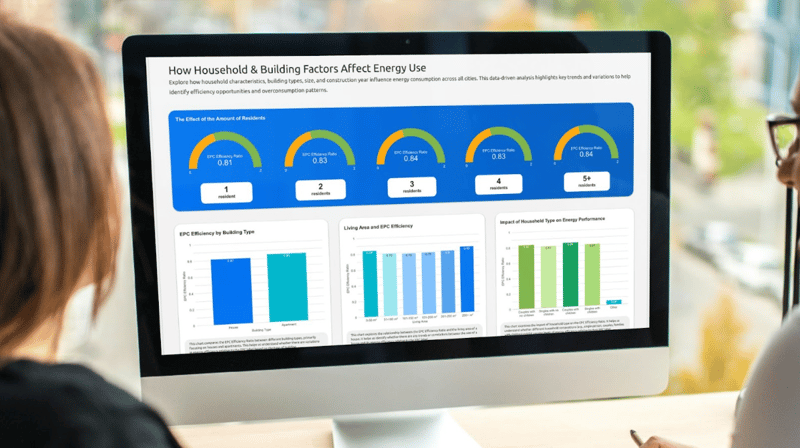
To prove this, we ourselves created a use case that visualises which neighbourhoods in Flanders are most suitable for shared energy grids.

DemoBlog 1
Let's work together

Discover how we can help accelerate your data ambitions!

Feel free to contact us and we'll be happy to help!

Data Flow - Data Mesh
Let's work together

Discover how we can help accelerate your data ambitions!

Feel free to contact us and we'll be happy to help!

Data Flow - Data Mesh
Let's work together

Discover how we can help accelerate your data ambitions!

Feel free to contact us and we'll be happy to help!

Data Flow - Data Mesh
Let's work together

Discover how we can help accelerate your data ambitions!

Feel free to contact us and we'll be happy to help!

Data Flow - Data Mesh

Gerelateerde Cases

A tremor in the Force. The last time I felt it was in the presence of my old master. Don't act so surprised, Your Highness. A tremor in the Force. A tremor in the Force. A tremor in the Force.

The Flemish government (public sector) faced fragmented real estate data spread across multiple agencies, making it difficult for citizens and stakeholders to access certificates, permits, and reports. ACA Group developed the Gebouwenpas, a scalable digital platform built on Liferay DXP with Spring Boot and Angular, centralising all building data into a single digital passport. Using an agile Scrum and Kanban approach, the solution delivers clear insights, secure access, and a future-proof system for both residential and non-residential properties.
OVAM_dossierdoolhof
OVAM_dossierdoolhof
OVAM-Leeuw-engels_groen-letteromtrek
I am ten, a marketing agency working with diverse project types such as retainers and time-based assignments, struggled to turn fragmented Jira data into actionable management insights. ACA Group implemented JirAlytics, a data platform built on top of Jira that integrates with tools like Power BI to centralise reporting on billability, budgets, and timesheets. This resulted in a scalable, centralised reporting environment, enabling management to monitor performance and make faster, data-driven decisions across all projects.
I am ten
I am ten
I am tem logo transparent
OVAM, the Public Waste Agency of Flanders, faced operational inefficiencies due to legacy IT systems and manual processes in case management and field operations. ACA Group implemented multiple applications using OutSystems low-code technology, including a web-based case management system, a mobile inspection app, and an asbestos cost calculation tool. This approach automated workflows, improved data accuracy, and reduced administrative effort, enabling faster processes, scalable digital solutions, and cost-efficient digital transformation across the organization.
sustainability visual
OVAM-Leeuw-engels_groen-letteromtrek
Smart Region Limburg (s-Lim), a collaboration of local governments, needed to reduce fragmentation in municipal communication and services across multiple municipalities. ACA Group developed Mijn Stadsapp, a cross-platform mobile application built with React Native that integrates data from various sources such as municipal websites, event platforms, and utility services. This solution centralizes local information and services in one app, improving citizen engagement and accessibility, and achieved rapid adoption with over 20,000 downloads in the first month.
mijn-stadsapp-bg-landscape
1717581376-s-lim-logo-transparant
A major Belgian bank needed to modernize its data management strategy to overcome limitations of centralized data architectures and enable scalable, domain-driven data usage. ACA Group guided the transition to a Data Mesh approach, combining strategic consulting, stakeholder alignment, and hands-on implementation of a self-service data platform using technologies such as Kubernetes. This resulted in a validated data product model, improved data ownership, and a scalable architecture that accelerates data-driven innovation and governance across the organization.
data mesh
data mesh
ACA Group logo
ACA Group, an international technology consultancy, faced fragmented onboarding processes across multiple offices, tools, and business units, creating inefficiencies for HR and inconsistent employee experiences. To address this, ACA Group developed N-ACA, a custom onboarding platform built with OutSystems low-code technology. The platform centralizes onboarding content, enables progress tracking, and standardizes workflows. This solution improved onboarding quality, reduced administrative workload for HR, and accelerated time-to-productivity for new employees.
rocket
rocket
ACA Group logo
The Flemish government (public sector) faced fragmented real estate data spread across multiple agencies, making it difficult for citizens and stakeholders to access certificates, permits, and reports. ACA Group developed the Gebouwenpas, a scalable digital platform built on Liferay DXP with Spring Boot and Angular, centralising all building data into a single digital passport. Using an agile Scrum and Kanban approach, the solution delivers clear insights, secure access, and a future-proof system for both residential and non-residential properties.
OVAM_dossierdoolhof
OVAM_dossierdoolhof
OVAM-Leeuw-engels_groen-letteromtrek
I am ten, a marketing agency working with diverse project types such as retainers and time-based assignments, struggled to turn fragmented Jira data into actionable management insights. ACA Group implemented JirAlytics, a data platform built on top of Jira that integrates with tools like Power BI to centralise reporting on billability, budgets, and timesheets. This resulted in a scalable, centralised reporting environment, enabling management to monitor performance and make faster, data-driven decisions across all projects.
I am ten
I am ten
I am tem logo transparent
OVAM, the Public Waste Agency of Flanders, faced operational inefficiencies due to legacy IT systems and manual processes in case management and field operations. ACA Group implemented multiple applications using OutSystems low-code technology, including a web-based case management system, a mobile inspection app, and an asbestos cost calculation tool. This approach automated workflows, improved data accuracy, and reduced administrative effort, enabling faster processes, scalable digital solutions, and cost-efficient digital transformation across the organization.
sustainability visual
OVAM-Leeuw-engels_groen-letteromtrek
Smart Region Limburg (s-Lim), a collaboration of local governments, needed to reduce fragmentation in municipal communication and services across multiple municipalities. ACA Group developed Mijn Stadsapp, a cross-platform mobile application built with React Native that integrates data from various sources such as municipal websites, event platforms, and utility services. This solution centralizes local information and services in one app, improving citizen engagement and accessibility, and achieved rapid adoption with over 20,000 downloads in the first month.
mijn-stadsapp-bg-landscape
1717581376-s-lim-logo-transparant
A major Belgian bank needed to modernize its data management strategy to overcome limitations of centralized data architectures and enable scalable, domain-driven data usage. ACA Group guided the transition to a Data Mesh approach, combining strategic consulting, stakeholder alignment, and hands-on implementation of a self-service data platform using technologies such as Kubernetes. This resulted in a validated data product model, improved data ownership, and a scalable architecture that accelerates data-driven innovation and governance across the organization.
data mesh
data mesh
ACA Group logo
ACA Group, an international technology consultancy, faced fragmented onboarding processes across multiple offices, tools, and business units, creating inefficiencies for HR and inconsistent employee experiences. To address this, ACA Group developed N-ACA, a custom onboarding platform built with OutSystems low-code technology. The platform centralizes onboarding content, enables progress tracking, and standardizes workflows. This solution improved onboarding quality, reduced administrative workload for HR, and accelerated time-to-productivity for new employees.
rocket
rocket
ACA Group logo

Share this case with your colleagues

Lorem ipsum dolor sit amet, consectetur adipiscing elit, sed do eiusmod tempor incididunt ut labore et dolore magna aliqua. Ut enim ad minim veniam, quis nostrud exercitation.

Share this via: