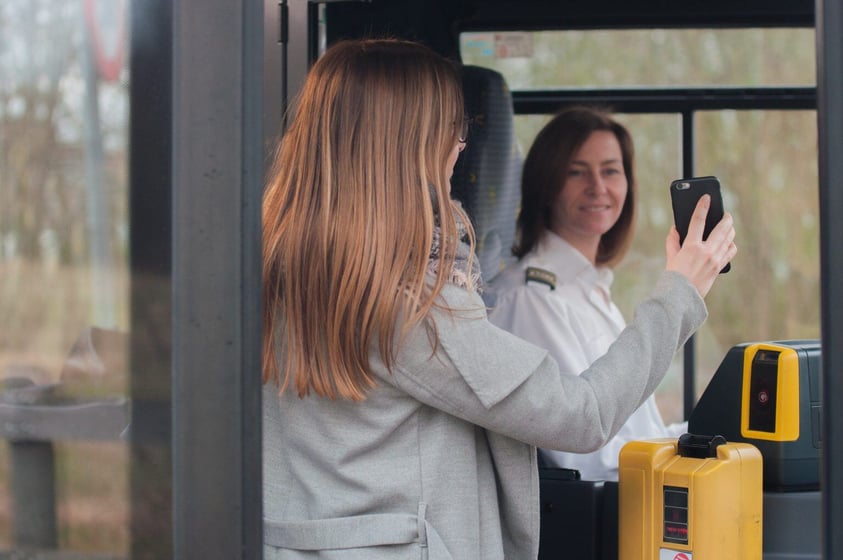
woman getting on bus
De_Lijn_logo

Last updated: 18 April 2025

User-friendly and accessible mobile app for De Lijn

De Lijn, a public transport operator in the mobility sector, needed an accessible and intuitive mobile app that supports all travelers, including visually impaired users. ACA Group redesigned the mobile application with improved navigation, real-time transit information, and a crowd barometer feature. This digital solution enhances accessibility, improves user experience, and enables more reliable and informed use of public transportation services.
 

Read more
01

Challenge

De Lijn required an innovative mobile app to address accessibility issues and improve the navigation and functionality of their existing mobile solutions.


02

Solution

The updated app integrates features for visually impaired users, a new route planner, real-time information enhancements, and a user-friendly navigation bar.


03

Approach

Through redesigning the app with accessibility best practices, integrating BLS features, and improving real-time functionality, De Lijn delivered an inclusive and effective mobile solution.


04

Result

De Lijn now offers a streamlined, accessible, and reliable app that meets diverse user needs and ensures seamless public transport experiences.

De_Lijn_logo

About De Lijn

The Flemish Transport Company De Lijn is an external autonomous agency within the Mobile & Public Works policy domain of the Flemish Government. De Lijn provides urban and regional public transport in, from and to Flanders, and wants to be the partner for sustainable and future-oriented mobility services. 
Challenge

An accessible and innovative mobile application

Accessibility is a very important aspect to De Lijn. That is why, for example, they only buy vehicles with a low step and elevated bus stops are (re)constructed in many places in Flanders to make it easier to get in and out of their vehicles.

This focus on accessibility also extends to De Lijn's mobile app. After all, the transport company wants users to be able to consult the app in a simple and user-friendly way. In addition, visually impaired users often rely on public transport, making it crucial to make the mobile app as user-friendly as possible for all audiences.

The last target audience often uses screen reader technology, such as VoiceOver on iOS and TalkBack on Android, where all information is read out loud from the screen. Previously, people with a visual impairment could consult a separate De Lijn app for this: De Lijn BLS. This app was optimized to better read out routes and real-time information. This application has become outdated in the meantime and is no longer provided with important updates.

Besides that, the 'normal' app of De Lijn was also due for renewal. This mobile app contained a complex navigation structure with a “hamburger menu” that was insufficiently user-friendly. After all, users had to keep pressing the menu button to navigate to certain sections of the app. Analytics showed that hardly any use was made of this menu button, while many functions were already available in this app, such as purchasing tickets, consulting the route planner, etc. There was therefore a need for renewal of both the regular De Lijn app and the BLS app.

Solution

A renewed and user-friendly mobile app for everyone

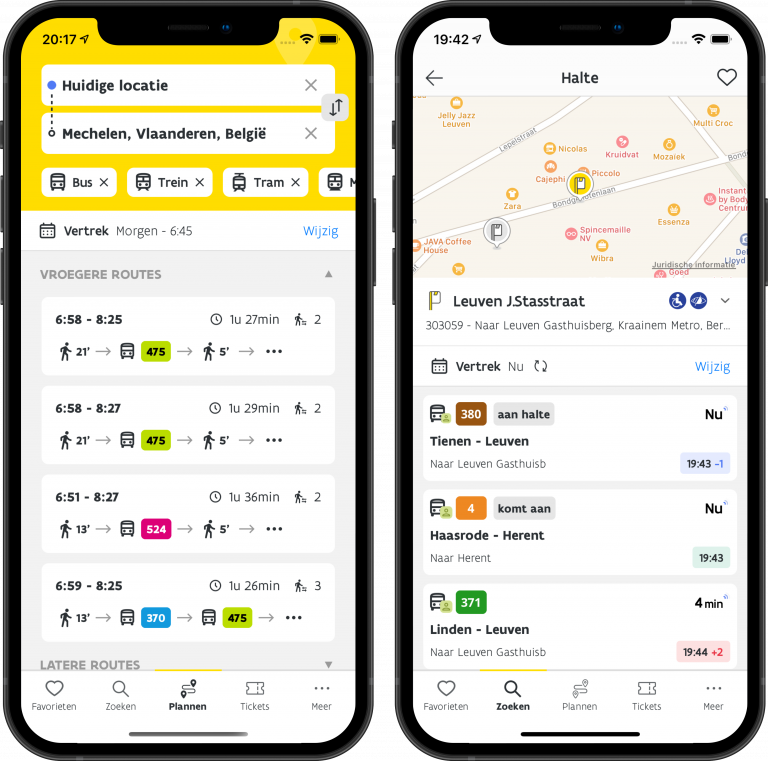
To ensure user-friendliness for all users, the existing mobile app was completely renewed. During this renewal, extra attention was paid to increasing the user-friendliness and accessibility of the app. The BLS app has been integrated into De Lijn's existing updated app, which is now able to read out routes and information about a stop. In addition, a new route planner has been integrated and users can see even more accurate real-time information.

Smartphone mockup with De Lijn app

In the new design of the app, we mainly focused on easy and user-friendly navigation, providing clear context when reading the screen and supporting larger text sizes. This means that De Lijn can call its app accessible, and they are more than ready for accessibility audits for mobile applications in the public sector.

In addition to the visual renewal of the app, we also worked on other innovations and improvements. With the motto "what is real-time, can still be real-timer" we looked at possibilities to make the app even more reliable for users.

Improved real-time info and a crowd barometer

At the start of the projects, we focused on improving the basic functionalities such as improving the real-time information and integrating the crowd barometer. With this crowd barometer, a traveler can see how busy it is on a particular bus or tram.

In terms of real-time information, we have made tremendous progress. In 97% of the cases, the traveler can check the app to see when a bus or tram will arrive at the stop. More than 92% of the information shown corresponds to reality with a margin of one minute or less. In addition, travelers can save routes as favorites and future trips are made easier because these routes can be quickly found in their own profile. The home screen shows the favorite stops along with the real-time information.

Approach

Inclusive design, advanced technology, and stakeholder collaboration

Our approach began with a thorough analysis of De Lijn's user base, focusing on visually impaired users, casual travelers, and daily commuters. We held collaborative workshops with De Lijn's team to identify key pain points in the existing apps and define the functional and accessibility goals for the new application. Accessibility guidelines for public sector mobile apps were central to our strategy.

We integrated the features of the outdated BLS app into the main app to provide a unified solution that met the needs of visually impaired users through screen reader technologies like VoiceOver for iOS and TalkBack for Android. For navigation, we replaced the confusing hamburger menu with a more intuitive bottom navigation bar, enabling users to quickly access essential features like ticket purchases, route planning, and personalized settings.

Real-time data was a critical component of our plan. By improving data integration, we ensured that bus and tram schedules were accurate 97% of the time, with 92% of real-time updates aligning to within one minute. Features like favorite routes, saved profiles, and a crowd barometer for gauging bus occupancy were developed to enhance usability. We also implemented best practices in UI/UX design to simplify navigation, support larger text sizes, and provide clear contextual cues for screen readers.

We prioritized continuous feedback, testing the app iteratively with real users, including those with disabilities, to refine its accessibility and functionality. Finally, we ensured that the app was future-proof by using scalable architecture and maintaining compatibility with App Store and Google Play Store requirements.

Result

A user-friendly app that delivers

After improving the basic functionalities and real-time information, we mainly shifted our focus to the design and user-friendliness of the app to make traveling even more comfortable. We replaced the previous hamburger menu with a navigation bar at the bottom of the screen. This gives users easy access to the various functions of the app, including purchasing tickets, plotting routes by train, tram, metro or bus, notifications for departure warnings and personalized information.

You can find the new app in the App store and Google Play Store.

Laten we samenwerken

Want to improve your mobile experience?    

We'd love to help you create a user-friendly mobile app customized to your needs. Get in touch today!

person using their mobile phone
Laten we samenwerken

Want to improve your mobile experience?    

We'd love to help you create a user-friendly mobile app customized to your needs. Get in touch today!

person using their mobile phone
Laten we samenwerken

Want to improve your mobile experience?    

We'd love to help you create a user-friendly mobile app customized to your needs. Get in touch today!

person using their mobile phone
Laten we samenwerken

Want to improve your mobile experience?    

We'd love to help you create a user-friendly mobile app customized to your needs. Get in touch today!

person using their mobile phone

Related cases

Discover how other companies transformed their digital solutions! Check out our related cases and see how we create innovative, user-friendly, and future-proof applications.

The Flemish government (public sector) faced fragmented real estate data spread across multiple agencies, making it difficult for citizens and stakeholders to access certificates, permits, and reports. ACA Group developed the Gebouwenpas, a scalable digital platform built on Liferay DXP with Spring Boot and Angular, centralising all building data into a single digital passport. Using an agile Scrum and Kanban approach, the solution delivers clear insights, secure access, and a future-proof system for both residential and non-residential properties.
OVAM_dossierdoolhof
OVAM_dossierdoolhof
OVAM-Leeuw-engels_groen-letteromtrek
I am ten, a marketing agency working with diverse project types such as retainers and time-based assignments, struggled to turn fragmented Jira data into actionable management insights. ACA Group implemented JirAlytics, a data platform built on top of Jira that integrates with tools like Power BI to centralise reporting on billability, budgets, and timesheets. This resulted in a scalable, centralised reporting environment, enabling management to monitor performance and make faster, data-driven decisions across all projects.
I am ten
I am ten
I am tem logo transparent
OVAM, the Public Waste Agency of Flanders, faced operational inefficiencies due to legacy IT systems and manual processes in case management and field operations. ACA Group implemented multiple applications using OutSystems low-code technology, including a web-based case management system, a mobile inspection app, and an asbestos cost calculation tool. This approach automated workflows, improved data accuracy, and reduced administrative effort, enabling faster processes, scalable digital solutions, and cost-efficient digital transformation across the organization.
sustainability visual
OVAM-Leeuw-engels_groen-letteromtrek
Smart Region Limburg (s-Lim), a collaboration of local governments, needed to reduce fragmentation in municipal communication and services across multiple municipalities. ACA Group developed Mijn Stadsapp, a cross-platform mobile application built with React Native that integrates data from various sources such as municipal websites, event platforms, and utility services. This solution centralizes local information and services in one app, improving citizen engagement and accessibility, and achieved rapid adoption with over 20,000 downloads in the first month.
mijn-stadsapp-bg-landscape
1717581376-s-lim-logo-transparant
A major Belgian bank needed to modernize its data management strategy to overcome limitations of centralized data architectures and enable scalable, domain-driven data usage. ACA Group guided the transition to a Data Mesh approach, combining strategic consulting, stakeholder alignment, and hands-on implementation of a self-service data platform using technologies such as Kubernetes. This resulted in a validated data product model, improved data ownership, and a scalable architecture that accelerates data-driven innovation and governance across the organization.
data mesh
data mesh
ACA Group logo
ACA Group, an international technology consultancy, faced fragmented onboarding processes across multiple offices, tools, and business units, creating inefficiencies for HR and inconsistent employee experiences. To address this, ACA Group developed N-ACA, a custom onboarding platform built with OutSystems low-code technology. The platform centralizes onboarding content, enables progress tracking, and standardizes workflows. This solution improved onboarding quality, reduced administrative workload for HR, and accelerated time-to-productivity for new employees.
rocket
rocket
ACA Group logo
The Flemish government (public sector) faced fragmented real estate data spread across multiple agencies, making it difficult for citizens and stakeholders to access certificates, permits, and reports. ACA Group developed the Gebouwenpas, a scalable digital platform built on Liferay DXP with Spring Boot and Angular, centralising all building data into a single digital passport. Using an agile Scrum and Kanban approach, the solution delivers clear insights, secure access, and a future-proof system for both residential and non-residential properties.
OVAM_dossierdoolhof
OVAM_dossierdoolhof
OVAM-Leeuw-engels_groen-letteromtrek
I am ten, a marketing agency working with diverse project types such as retainers and time-based assignments, struggled to turn fragmented Jira data into actionable management insights. ACA Group implemented JirAlytics, a data platform built on top of Jira that integrates with tools like Power BI to centralise reporting on billability, budgets, and timesheets. This resulted in a scalable, centralised reporting environment, enabling management to monitor performance and make faster, data-driven decisions across all projects.
I am ten
I am ten
I am tem logo transparent
OVAM, the Public Waste Agency of Flanders, faced operational inefficiencies due to legacy IT systems and manual processes in case management and field operations. ACA Group implemented multiple applications using OutSystems low-code technology, including a web-based case management system, a mobile inspection app, and an asbestos cost calculation tool. This approach automated workflows, improved data accuracy, and reduced administrative effort, enabling faster processes, scalable digital solutions, and cost-efficient digital transformation across the organization.
sustainability visual
OVAM-Leeuw-engels_groen-letteromtrek
Smart Region Limburg (s-Lim), a collaboration of local governments, needed to reduce fragmentation in municipal communication and services across multiple municipalities. ACA Group developed Mijn Stadsapp, a cross-platform mobile application built with React Native that integrates data from various sources such as municipal websites, event platforms, and utility services. This solution centralizes local information and services in one app, improving citizen engagement and accessibility, and achieved rapid adoption with over 20,000 downloads in the first month.
mijn-stadsapp-bg-landscape
1717581376-s-lim-logo-transparant
A major Belgian bank needed to modernize its data management strategy to overcome limitations of centralized data architectures and enable scalable, domain-driven data usage. ACA Group guided the transition to a Data Mesh approach, combining strategic consulting, stakeholder alignment, and hands-on implementation of a self-service data platform using technologies such as Kubernetes. This resulted in a validated data product model, improved data ownership, and a scalable architecture that accelerates data-driven innovation and governance across the organization.
data mesh
data mesh
ACA Group logo
ACA Group, an international technology consultancy, faced fragmented onboarding processes across multiple offices, tools, and business units, creating inefficiencies for HR and inconsistent employee experiences. To address this, ACA Group developed N-ACA, a custom onboarding platform built with OutSystems low-code technology. The platform centralizes onboarding content, enables progress tracking, and standardizes workflows. This solution improved onboarding quality, reduced administrative workload for HR, and accelerated time-to-productivity for new employees.
rocket
rocket
ACA Group logo

📲 Share the case in your team

Share via: