
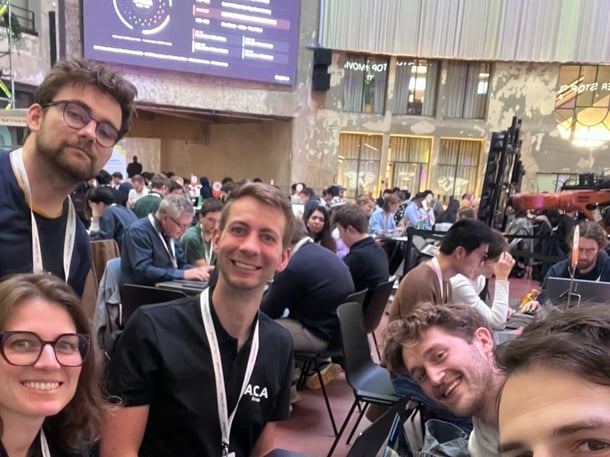
On Thursday 29 October 2026, Joppe Weustenraad, Eva Braeckman, Jef Suffeleers, Jonas Haesevoets and Tom Beuckelaere of ACA Group headed to Hacking for Good (Solve with Google 2026). There, Google Cloud, Google Research and BSPHO, the Belgian Society of Paediatric Haematology Oncology, brought together 40 teams to work on paediatric oncology. They had one day to build something that makes life a little easier for children with cancer. By the end of it, AImesis was up and running. A working web app that helps doctors, pharmacists and families get a better grip on nausea caused by chemotherapy.
They teamed up with two people who see this problem up close every day: hospital pharmacists Katleen Balliauw and Anthe De Pauw of UZA. Their question was about something almost every child with cancer goes through. Chemotherapy Induced Nausea and Vomiting, or CINV. In plain words, the heavy nausea and vomiting after a round of chemo. The team's motto wrote itself. "Every child with cancer deserves comfort!"
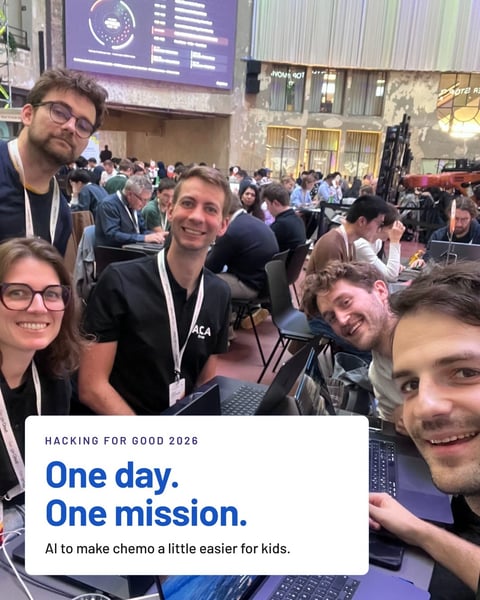
Joppe, Eva, Jef, Jonas and Tom at Hacking for Good.
AImesis in short
When
Thursday 29 October 2026, Hacking for Good (Solve with Google 2026), with 40 teams
Team ACA
Joppe Weustenraad, Eva Braeckman, Jef Suffeleers, Jonas Haesevoets and Tom Beuckelaere
Together with
Katleen Balliauw and Anthe De Pauw, hospital pharmacists at UZA
Built with
Google Cloud Agent Development Kit (ADK), Gemini, Python tool calls and Retrieval Augmented Generation (RAG)
Why is one prescription such a puzzle?
Prescribing medication against nausea sounds routine. For children, it's anything but. No two children react the same way and no two chemo courses are alike.
Take a toddler of two. Little ones don't swallow big pills, so you need a syrup, a melt tablet or an IV. If the drink tastes awful, it simply stays on the table. And some children already feel sick the moment the hospital doors slide open.
Then there are the medical risks. Some chemo agents are manageable on their own, but suddenly very heavy together. Doctors have to watch for dangerous interactions, for example with antifungals or drugs that affect heart rhythm. And some combinations are simply off limits. To check all of that, doctors and pharmacists today leaf through thick PDF guidelines, international tables and scattered hospital notes. That's time they would much rather spend with their patients.
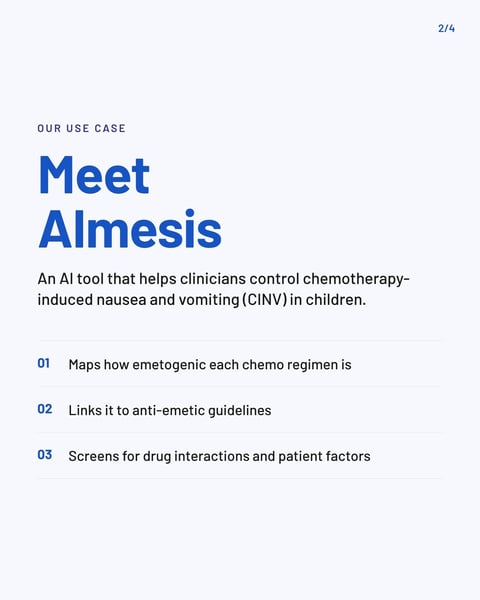
AImesis at a glance.
A copilot that always shows its working
The first part of AImesis is for paediatric oncologists and hospital pharmacists. They pick a patient in a clear cockpit, or simply type their question to an AI assistant we built with Google Cloud's Agent Development Kit and Gemini. A nursing note from the last course? Just paste it in.
One thing was clear from the first minute. You don't let a language model do mental arithmetic with children's doses. So the AI understands the doctor's question, but hands every calculation to fixed Python functions through tool calls. Same input, same result, every time.
Those functions first work out the child's body surface area (BSA) from height and weight. Next, they determine how intensive the chemo course is and calculate the dose down to the milligram and millilitre. The safety rules from the UZA protocol are built right in.
The doctor sees the answer, and also the formula, the data used and the rounding rules. A parameter looks off? Change it and run it again. The final call always belongs to the specialist, because no regimen goes ahead without their approval.
How does the doctor know where advice comes from?
AImesis only draws its medical knowledge from the documentation the experts provided themselves. We do that with Retrieval Augmented Generation (RAG).
It gets really useful when sources disagree. A local hospital protocol sometimes uses a different threshold for a drug than the international literature. AImesis puts all sources side by side and tells the doctor straight away, with the page number, the table number and a verbatim quote. So the doctor can check any recommendation in seconds.
What if a child feels sick at home?
Treatment doesn't end with the prescription. That's why we also built a mobile Companion App for children and their parents, in Dutch, French and English.
In it, they find their Patient Passport, with a clear schedule for home, tips for dehydration and links to Belgian support organisations. And they can easily let the care team know how they're doing.
A sick child won't fill in forms. So we kept it to big, visual buttons (Nauseous, Vomiting, Rescue medication taken) and a simple scale. Feeling sick again on Friday at 5 pm, two hours after the 3 pm medication? One tap is enough.
That report lands straight in the doctor's cockpit. When the child comes back a few weeks later for the next course, the AI takes it into account and proposes a stronger or adjusted regimen. Every tap from home counts towards the next treatment.
What did our team bring to the hackathon?
Joppe, Eva, Jef, Jonas and Tom had one day. That they pulled it off has everything to do with what they do at ACA every day.
They know Google Cloud inside out. We build on Google Cloud every day, with Vertex AI, Gemini and BigQuery. In October 2026, TD SYNNEX named ACA Group Google Cloud Partner of the Year. Setting up an agent with ADK and Gemini was familiar ground.
They build AI you can check. The language model does what it's good at, understanding the doctor's question. The maths lives in fixed code and every source can be traced. It's also how we build AI agents for our clients, agents that plan and act on their own, within clear limits.
They turn scattered documents into usable knowledge. Guidelines, tables and notes became one searchable knowledge base, with conflicts clearly flagged. We do the same for clients, with LLM solutions for documents and knowledge and the work of our data experts.
They think about who's holding the screen. A specialist needs something very different from a child of six. So there are two screens. A cockpit for the doctor and a multilingual mobile app with big buttons for the family. Designing from the user up is at the heart of our Digital Experience Design work.
Four choices that made the difference
| Choice | What it delivers |
|---|---|
| Calculations in fixed Python functions | Doses down to the milligram, following the UZA protocol |
| RAG with citations | Page number, table number and quote with every recommendation, plus a flag when sources clash |
| The doctor decides | Formula, data and rounding are visible and every regimen needs approval |
| Feedback from home | Reports from the app shape the next regimen |
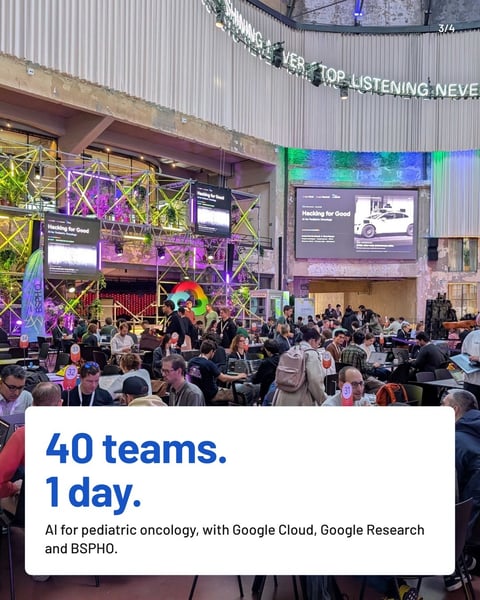
40 teams, one day.
So who actually wins?
From an almost endless number of combinations of drugs, schedules and formulations, AImesis comes up with a safe, personalised proposal in seconds.
Winning or losing wasn't the point that Thursday. The real winners are the hospitals and BSPHO, who now have a working prototype to improve their clinical processes with. And, secretly, so are we. Joppe, Eva, Jef, Jonas and Tom learned a lot on the technical side, but above all they went home feeling their work mattered. For children who deserve every bit of comfort during a gruelling treatment.
What we can build for you
What the team built in one day, we do every day for our clients.
- Agentic AI. AI agents that analyse information, plan and carry out tasks.
- LLM solutions. Assistants and document processing that make your knowledge searchable.
- Google Cloud. AI and data on Vertex AI, Gemini and BigQuery, from strategy to managed services.
- Mobile. Apps people actually use, on any device.
- Digital Experience Design. Screens designed for the people using them, from specialist to child.
Frequently asked questions
What is AImesis?
AImesis is a prototype an ACA Group team built in one day on 29 October 2026 at Hacking for Good (Solve with Google 2026) with Google Cloud, Google Research and BSPHO. It helps paediatric oncologists and hospital pharmacists prescribe medication for nausea caused by chemotherapy. Children and parents report how they feel through a mobile app.
Which technology is behind AImesis?
The AI assistant runs on Google Cloud's Agent Development Kit and Gemini. Calculations run in fixed Python functions through tool calls. Through Retrieval Augmented Generation, its medical knowledge comes only from guidelines the experts provided.
Does the AI make medical decisions on its own?
No. The AI makes a proposal and shows which formula, data and sources it used. The treating specialist has to explicitly approve every regimen.
Building AI your organisation can trust?
See how we build AI solutions you can explain, check and build on.
Read more
ACA Group named Google Cloud Partner of the Year at TD SYNNEX Cloud Summit 2026
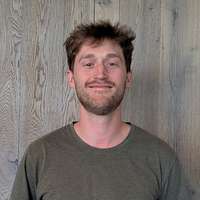
What others have also read

Young talents get hands-on with Opencode during our AI Hackaton On July 22, 2026, our Young Talent Network held an AI Hackathon, guided by Tim Lefever and Maxime Detollenaere. Our young talents had ninety minutes to work with Opencode and design MCPs
Read more
Wednesday May 27th 2026 — The Cloud team headed to Amsterdam for the AWS Summit. A free conference where AWS enthusiasts and experts come together, new technologies get the spotlight, and one question keeps coming back throughout the day: what are yo
Read more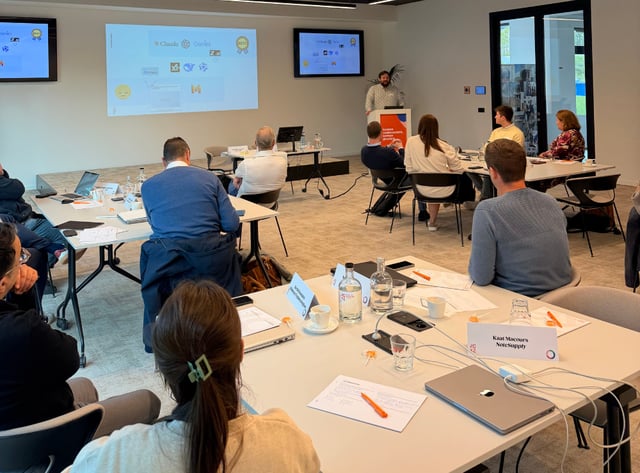
What can AI truly mean for businesses today? And perhaps even more importantly: where does it not add value?
Read moreWant to dive deeper into this topic?
Get in touch with our experts today. They are happy to help!
Want to dive deeper into this topic?
Get in touch with our experts today. They are happy to help!