.svg?width=174&auto=compress,webp&upscale=true)

Reading time 7 min
Stefan Faes
 Tom Claus
Wind turbines, solar parks and batteries get most of the attention when it comes to the energy transition. Understandable, because that's where the investment sits. But for energy producers and asset managers, the real challenge isn't in the hardware itself. It's in the layer in between: market integration.
Because between a production forecast and a sold megawatt-hour on the market lies a complex chain of systems, processes and partners. Forecasting, portfolio optimisation, nominations, trading, asset control and settlement all need to work together seamlessly. When one link fails, the operational and financial consequences can follow quickly.
Market integration is the combination of processes, systems and data flows that connect energy assets to energy markets.
For energy producers, this means that production forecasts, market information, optimisation algorithms, trading platforms and operational systems need to continuously exchange information with each other.
A typical chain looks like this:
Asset → Forecasting → Portfolio optimisation → BRP nomination → Day-ahead market → Asset control → Settlement and imbalance management
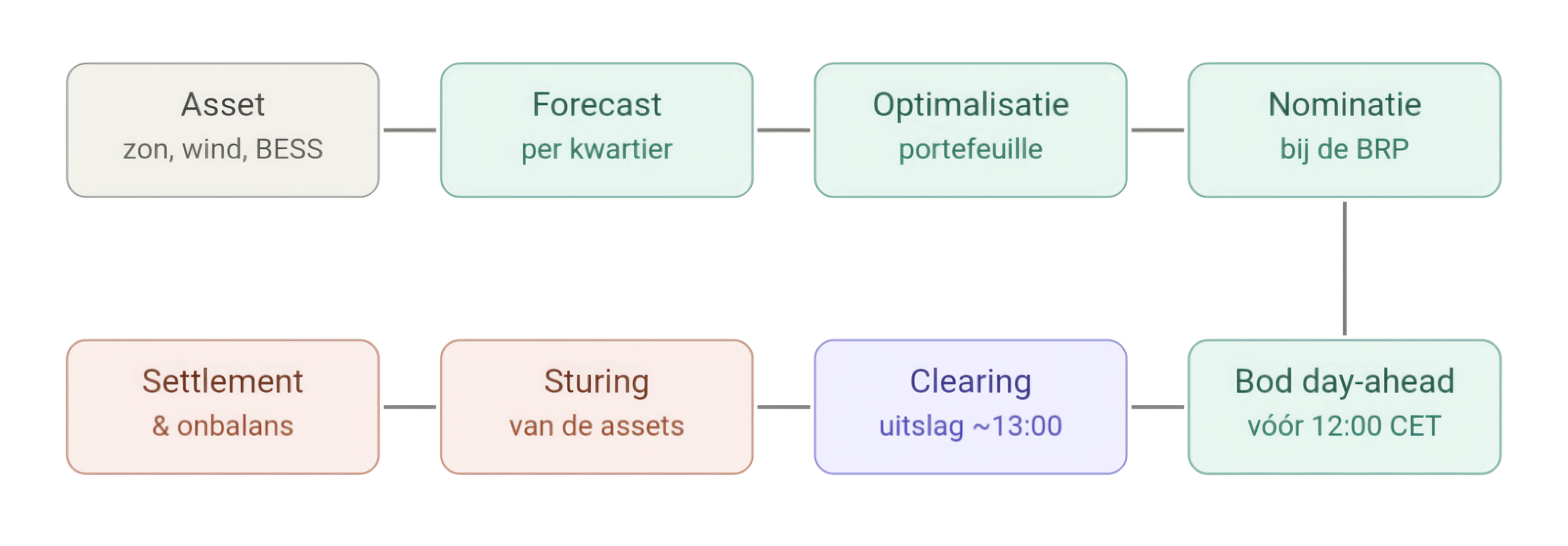
On paper, that looks straightforward. In practice, each step consists of different systems, data sources and partners that need to communicate with each other at exactly the right moment.
The energy market is evolving fast. Renewable energy, flexibility and battery storage are creating more dynamics than ever before.
On top of that, European energy markets are increasingly working with quarter-hour values instead of hourly values. For the day-ahead market, that means 96 time blocks per day instead of 24.
This offers advantages for integrating wind and solar energy, but at the same time increases complexity.
More granularity means more data, more calculations and more dependencies between systems. And therefore less room for errors.
Meanwhile, deadlines remain just as strict. Forecasts need to be available on time, bids need to be processed correctly and market results need to be translated quickly into concrete actions for the assets.
Many organisations invest in forecasting, trading software or asset management tools. Yet we see that problems often don't arise within one system, but between systems.
Typical challenges include:
The result? A problem that originates in forecasting sometimes only becomes visible during settlement or in the imbalance settlement.
The more complex the landscape, the more important it becomes to view the entire chain as one whole.
Many energy companies today work with multiple specialised partners.
One party provides forecasting. Another handles trading. Yet another manages assets, data or optimisation.
This offers flexibility and allows organisations to choose the best solution for each domain.
But that freedom also brings challenges.
As soon as different systems and suppliers need to work together, there's a need for a robust integration layer that ensures data flows correctly, on time and reliably throughout the entire chain.
That's why more and more organisations are choosing a vendor-agnostic approach. Not putting everything with one supplier, but making sure all components work together efficiently.
ACA Group helps energy producers and asset managers design, build and manage reliable market integration platforms.
We don't replace existing partners and we don't develop trading strategies. Our role is to build the technical and data architecture that connects all parts of the chain.
That includes:
Our strength lies in combining software expertise with a deep understanding of the energy market.
Because successful market integration requires more than technology alone. It requires insight into both the operational reality of energy producers and the technical challenges behind the scenes.
Are you working with multiple systems, data sources or partners that together support your market processes? And are you wondering whether your current integration is sufficiently reliable, scalable and future-proof?
We'd love to have that conversation.
During a no-obligation sparring session, we'll look together at where the biggest dependencies and risks sit within your market integration chain and what improvements are possible.

From February 3 to 5, Liferay welcomed its global teams and partners to Athens for the Liferay Sales Kickoff (SKO) . During this annual event, Liferay presents its strategic direction and new features for the upcoming year. Liferay SKO is the place w
Read more

When building products, there is a growing recognition that success isn’t just about delivering features or hitting deadlines. Instead, it’s about delivering real value to customers and achieving business impact. This requires a shift in mindset from
Read more

Ever wondered why one website is easy to use whereas other sites only bring frustrations? Why you are happy to use that one particular app on a day-to-day basis and you would rather ignore other apps as much as possible? The thing is that, in most ca
Read moreBusiness Expert Energy & Utilities at ACA Group.

Business Expert Energy & Utilities at ACA Group.